
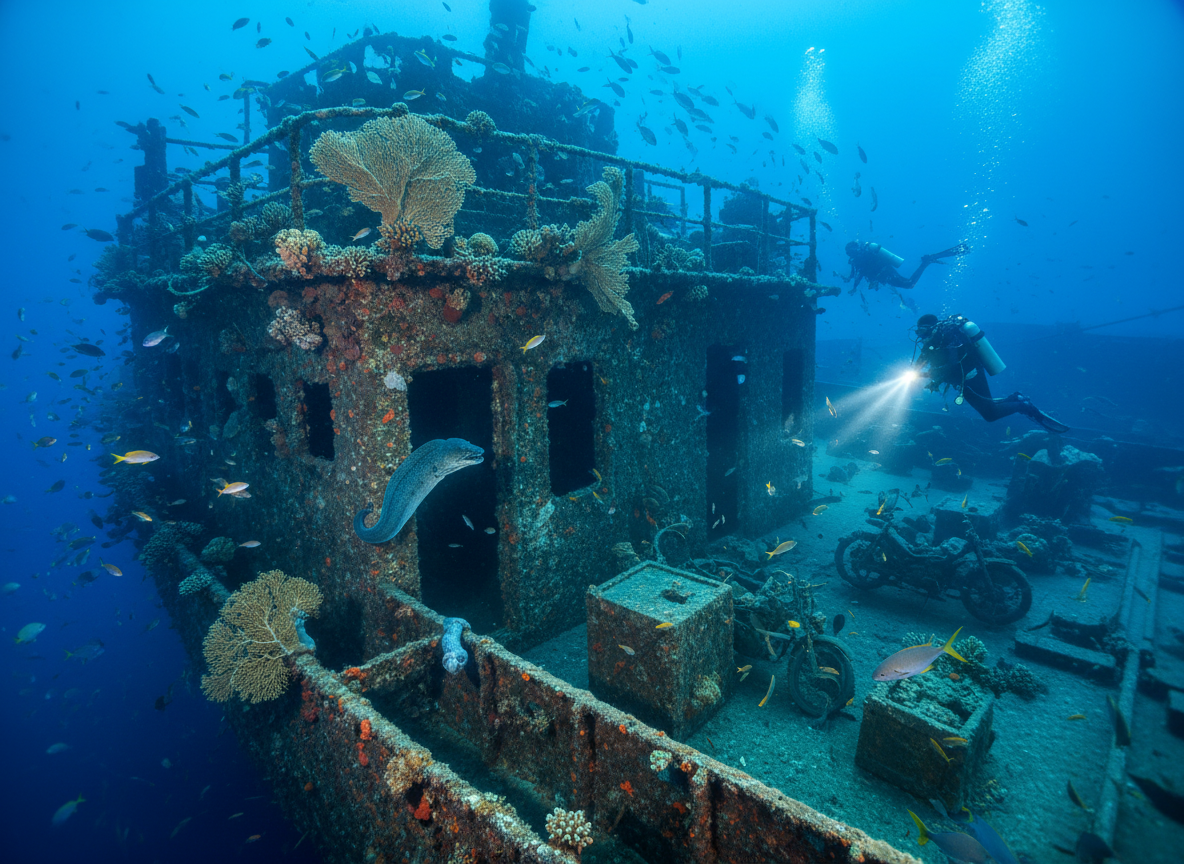
SS Thistlegorm — Complete Red Sea Wreck Dive Guide 2026
Ask a room of experienced Red Sea divers to name the best wreck in the world and the SS Thistlegorm will come up again and again. Lying in the Strait of Gubal in Egypt’s northern Red Sea, a few hours by boat from Sharm El Sheikh, this WWII time capsule combines easy access, atmospheric cargo holds, and intense history in a way no other wreck quite matches.
From the first moment you drop down the mooring line and see the bow emerge from the blue, you understand why people cross continents to dive it. Motorcycles, Bedford trucks, rifles, boots, and even locomotives are still in place where they were loaded in 1941. With more than 20 years of guiding the site, Horus Diving Safari has refined a way of diving the Thistlegorm that shows you the best of the wreck, safely and without feeling rushed.
SS Thistlegorm — Quick Facts
- Location: Strait of Gubal, northern Red Sea, Egypt
- Depth: 16–32 m (deck around 16–18 m, seabed around 30–32 m)
- Length: 126 m British armed merchant vessel
- Sunk: 6 October 1941 by German bombers while at anchor
- Discovered for sport diving: located by Jacques Cousteau in 1955
- Experience level: suitable for all certified divers — Open Water and above, with no mandatory decompression
- Access: long-range boats from Sharm El Sheikh, best dived by liveaboard
The Wreck — How the SS Thistlegorm Was Lost and Found
The SS Thistlegorm was a 126 m British armed merchant vessel launched in 1940. Her job was simple but crucial: carry war supplies from the UK to the British 8th Army fighting in North Africa. On her final voyage she left Glasgow in June 1941 loaded with everything a desert army could burn through:
- BSA military motorcycles stacked in tight rows
- Bedford trucks, many with bikes and crates loaded onto their flatbeds
- Lee–Enfield rifles, ammunition, and anti-aircraft shells
- Army boots still paired in their boxes
- Locomotives and tenders stowed on deck
- Spare tank tracks, aircraft parts, and general stores
By October 1941 the ship was at anchor in the Strait of Gubal, waiting for the Suez Canal to reopen. Just after midnight on 6 October, German Heinkel bombers from Crete located the vessel. Two bombs struck Hold 4, where ammunition and explosives were stored. The blast blew the stern apart, snapped the ship almost in two, and she sank rapidly, coming to rest upright in 16–32 m of water.
For more than a decade the Thistlegorm lay largely undisturbed. In 1955, Jacques Cousteau located the wreck while exploring the Red Sea, filming its cargo holds and briefly putting it on the map. Then it slipped back into obscurity until recreational diving took off in Sharm El Sheikh in the 1990s. Today, the SS Thistlegorm is the signature wreck of northern Red Sea wreck diving and a core stop on Horus Diving Safari’s week-long liveaboard itineraries.
What You’ll See — Inside the Thistlegorm
Most divers do 3–4 dives on the Thistlegorm across a day and still leave wanting more. The wreck is big, complex, and absolutely packed with detail. Here’s how the main areas break down.
Holds 1 & 2 — BSA Motorcycles and Bedford Trucks
Holds 1 and 2 are the heart of the dive. This is where you find:
- BSA motorcycles lined up in neat rows, many still chained in place
- Bedford trucks with bikes, crates, and equipment loaded in their beds
- Ammunition, rifles, and parts stacked along the bulkheads
- Boxes of army boots still in pairs, laced and ready to wear
This is the “postcard” Thistlegorm scene: motorbikes silhouetted against blue light streaming through the hatch, dust hanging in the water column, and your torch picking out headlamps and handlebars. Our guides use well-established penetration routes that keep you in the best-lit sections while avoiding the tightest silt pockets and congestion from other groups.
Holds 3 & 4 — Railway Wagons, Ammunition, and Boots
Further aft, Holds 3 and 4 show more of the ship’s role as a floating warehouse and transport hub:
- Railway wagons loaded with supplies
- Crates of Lee–Enfield rifles stacked in racks
- Ammunition boxes piled high along the sides
- Rubber boots and kit still bundled together
- Twisted remains of the area where the bombs struck
These holds are darker and more enclosed, so a good torch is essential. The atmosphere here is very different from the brighter motorcycle decks — more somber, with a stronger sense of being inside a working warship.
The Locomotive, Railway Wagons, and Stern Gun
On the deck and seabed you’ll see some of the Thistlegorm’s most surreal cargo:
- A steam locomotive and tender blown clear of the ship, now lying off the stern on the sand
- Railway wagons scattered on the seabed and along the deck
- The stern gun and an anti-aircraft gun still mounted, aimed out into the blue
- Winches, capstans, and deck fittings smothered in soft corals and sponges
Depending on current, we often plan one dive that loops from the bow along the deck, out to the locomotive, and back to the forward section, giving wide-angle photographers plenty of time on the external structures.
Marine Life — A Wreck Turned Artificial Reef
Although you come for the history, the marine life is a serious bonus. Typical sightings include:
- Masses of glassfish filling the holds and companionways
- Lionfish hunting under the overhangs and around the mast
- Schools of trevally and snapper working the current along the bow
- Large groupers, barracuda, and the occasional reef shark cruising the perimeter
- A mast and railing system completely coated in soft corals, especially on the upstream side
We treat the Thistlegorm as both a war grave and a living reef: no touching the cargo, no entering unbriefed penetration routes, and absolutely no souvenir hunting. The goal is to leave the site exactly as you found it.
Dive Conditions on the SS Thistlegorm
Knowing what to expect on the wreck helps you plan safer, longer dives. Here are the key SS Thistlegorm dive conditions.
- Depth: 16–32 m (deck around 16–18 m, deepest holds and seabed around 30–32 m)
- Experience level: suitable for all certified divers. We keep newer divers on the shallower decks and the outside of the wreck, with more advanced routes for those with wreck or deep training.
- Visibility: typically 15–30 m, often crystal clear from October to May.
- Current: can be strong on the surface and around the bow. We plan our Red Sea wreck dives for slack tide and use fixed moorings and descent lines.
- Water temperature: roughly 22–24 °C in winter, 26–28 °C in summer. Most divers are comfortable in a 5 mm suit plus hood in the cooler months.
- Night dives: outstanding when conditions allow. Glassfish clouds, hunting lionfish, and torch-lit cargo make the wreck feel completely different after dark.
- Gas choice: nitrox is strongly recommended to extend no-decompression limits and reduce fatigue over multiple dives.
Best Time to Dive the SS Thistlegorm
You can dive the Thistlegorm all year, but some months clearly offer better visibility, more pleasant water temperatures, and fewer boats. For a full seasonal breakdown of Red Sea conditions, see our detailed guide to the best time to dive the Red Sea. In short:
- Autumn (September–November): peak window. Excellent visibility, warm water, and slightly fewer day boats than high summer.
- Winter (December–February): coolest air and water (22–24 °C), but often the clearest visibility and calmest seas, with noticeably fewer divers on the wreck.
- Spring (March–May): comfortable temperatures and reliably good visibility. Routes are busier, but still manageable with good timing.
- Summer (June–August): very warm water and hot air. Visibility can be hazier and currents stronger. We avoid midday visits in July–August when the wreck is most crowded and instead plan dawn or late-afternoon dives.
Horus Diving Safari schedules our 2026 SS Thistlegorm itineraries to hit the best balance of visibility, temperature, and low crowd levels so you maximise time on the wreck rather than waiting for holds to clear.
Liveaboard vs Day Trip — What’s the Best Way to Dive It?
You can reach the SS Thistlegorm either on a long-range day boat from Sharm El Sheikh or as part of a dedicated liveaboard safari. For serious Red Sea wreck diving, there is a clear winner.
| Question | Liveaboard (Horus Diving Safari) | Day Trip from Sharm |
|---|---|---|
| Number of dives on the Thistlegorm | Typically 3–4 dives over one full day | Usually 2 dives, sometimes 3 if conditions allow |
| Time of first dive | Dawn or early morning, often alone on the wreck | Late morning once most boats have arrived |
| Crowds in the holds | Minimal — we dive before peak traffic | High, with multiple groups sharing the same routes |
| Travel time | Overnight positioning while you sleep | 2–3 hours each way by boat in the same day |
| Overall experience | Unhurried routes, longer bottom times, flexible plans | Compressed schedule with stricter time pressure |
| Our recommendation | Best choice for anyone who cares about photography, history, or maximising wreck time | Fine if your schedule is tight and you only want a “taster” of the wreck |
Horus Diving Safari specialises in liveaboard diving. Our boats overnight directly on the Thistlegorm moorings, giving you quiet sunrise dives when the holds are still clear, followed by a full day of varied routes including night dives. Explore options and departure dates on our main liveaboard schedule.
How to Get There — Logistics from Sharm El Sheikh
The SS Thistlegorm lies in the Strait of Gubal, roughly 40 km off the Egyptian mainland. All recreational access is by boat from Sharm El Sheikh, with an overnight 4–6 hour repositioning sail for liveaboards.
Day Trips from Sharm El Sheikh
- Boat time: 3–4 hours each way, depending on sea state and vessel speed.
- Schedule: very early departure from the marina, two dives on the wreck (occasionally three), then return late afternoon or early evening.
- Who it suits: divers on resort holidays in Sharm with limited time, or those wanting to sample the wreck before committing to a full Red Sea liveaboard.
Liveaboard Safaris with Horus Diving Safari
- Departure: embark in Sharm El Sheikh, cruise overnight with a 4–6 hour sail to arrive above the wreck before sunrise.
- On-site: the boat stays moored on the Thistlegorm for the day, giving you multiple day and night dives without extra transit.
- Advantages: no long return crossing on the same day you dive; more rest, more bottom time, and far better timing for currents and crowds.
All of our Thistlegorm-inclusive safaris start and end in Sharm El Sheikh, with airport transfers available. Check dates and routes on the Horus Diving Safari homepage.
Photography Tips — Getting the Shot
The Thistlegorm is one of the most photographed wrecks on the planet. That also means it’s easy to come home with the same images as everyone else. A little planning makes a big difference to your SS Thistlegorm photo dive.
- Go wide-angle: a fisheye or ultra-wide zoom is ideal. The holds are tight but the subjects are big, and you want to work close to minimise backscatter.
- Prioritise the motorcycle holds: Holds 1 and 2 are where the iconic shots are. We schedule a dedicated “photo dive” here when group experience allows.
- Use the first dive of the day: early morning light through the hatches, fewer divers, and cleaner water create the best conditions for stills and video.
- Bring a good torch: not just for safety, but to paint detail on dashboards, headlamps, boots, and rifles inside the holds.
- Slow down: pick one or two subjects per dive instead of trying to “collect” everything. The best images come when you spend five minutes on one bike, not five seconds on ten.
- Watch your buoyancy and kicks: a single careless flutter can turn a perfect hold into a snowstorm of silt for every photographer behind you.
Nearby Sites Worth Combining with the Thistlegorm
The Thistlegorm is the star, but a good Red Sea itinerary builds a full week around it. Horus Diving Safari pairs the wreck with some of the region’s best reefs and offshore seamounts:
- Ras Mohammed National Park — towering walls, schooling barracuda and snapper, and dramatic currents at Shark & Yolanda.
- The Brothers Islands — remote offshore pinnacles famous for oceanic whitetips, thresher sharks, and dense soft coral coverage.
- Daedalus Reef — a true offshore seamount with pelagic encounters, hammerhead sightings in season, and classic deep-blue wall diving.
Our 7-night routes are built so that the Thistlegorm sits alongside at least one of these “headline” sites, giving you a balance of historic wrecks and world-class reef diving in a single trip.
Dive the Thistlegorm with Horus Diving Safari
If you want to experience the SS Thistlegorm at its best — quiet dawn descents, carefully planned penetration routes, and guides who know every hold and ladder by heart — a dedicated liveaboard is the way to do it. Horus Diving Safari has been running Red Sea liveaboard safaris for more than 20 years, with small groups, nitrox on board, and experienced PADI professionals leading every dive.
- All-inclusive liveaboard trips from €550 per person
- Small groups with routes tailored to your experience level
- Expert PADI guides and cruise directors who know the wreck intimately
- Itineraries that combine the Thistlegorm with Ras Mohammed and other Red Sea highlights
Ready to plan your 2026 Thistlegorm adventure? Visit the Horus Diving Safari homepage to check dates, routes, and availability, or contact our team and we’ll help you choose the perfect week to finally tick this legendary Red Sea wreck dive off your list.
Leave a Reply